BIP! Scholar at TPDL 2026
International Conference on Theory and Practice of Digital Libraries
01-10-2026
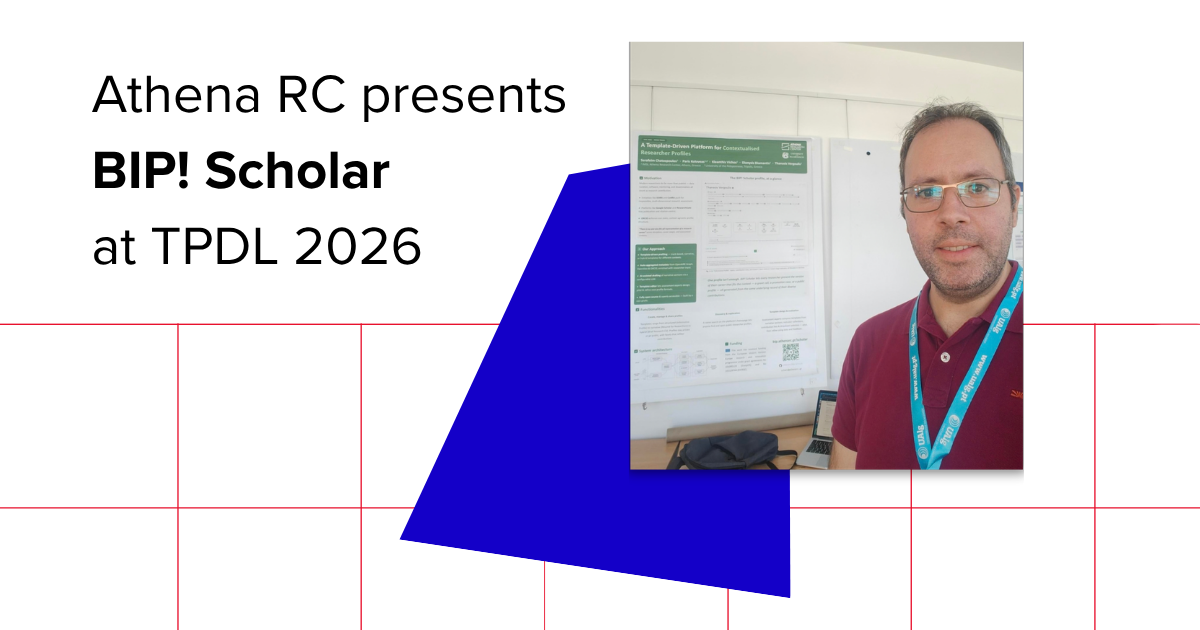
On 22–25 September 2026, Dr Serafeim Chatzopoulos, Scientific Associate at the Information Management Systems Institute (IMSI) of ATHENA Research Center, took part in the 30th International Conference on Theory and Practice of Digital Libraries (TPDL 2026), hosted by the University of Algarve in Faro, Portugal. At the conference, Dr Chatzopoulos presented a demo of BIP! Scholar, a researcher profiling platform developed at IMSI.
TPDL is a well-established international forum for research and practice in digital libraries. Its topics range from information management and retrieval to the monitoring and assessment of science. This year's edition placed particular emphasis on innovative yet usable, reliable and sustainable approaches with real-world applications.
Today's researchers do far more than publish papers. They develop software, create and curate datasets, review, mentor, engage with communities and inform policy. Initiatives such as CoARA and DORA increasingly call for these contributions to be recognised. However, most researcher profiling platforms still revolve around publication lists and citation-based metrics. BIP! Scholar addresses this gap. Following a major redesign in the context of the GraspOS project, it has evolved from a single-template platform into a fully template-driven environment. Researchers can now create different profiles tailored to different presentation or assessment contexts, using three kinds of templates:
-
track-based templates
-
narrative-style templates
-
hybrid templates that combine structured evidence with narrative elements
Profiles can include datasets, software and other research products, as well as contribution roles and narrative descriptions. They are automatically enriched with topics, indicators and other metadata from open scholarly infrastructures, primarily the OpenAIRE Graph.
The platform also serves research assessment experts. They can design experimental profile templates, test them with volunteer researchers, and refine them based on feedback. This turns BIP! Scholar into a hands-on testbed for new approaches to research assessment.
The demo paper describing the platform will appear in the TPDL 2026 proceedings. A preprint is already available on arXiv. You can also learn more about BIP! Scholar in the BIP! blog post, “Reimagining Researcher Profiles with BIP! Scholar”, or see how SSH researchers have used BIP! Scholar in practice through the relevant testimonial.