ATRIUM
ATRIUM will exploit and strengthen complementarities between leading Εuropean infrastructures: DARIAH, ARIADNE, CLARIN and OPERAS in order to provide vastly improved access to a rich portfolio of state-of-the-art services available to researchers across countries, languages, domains and media, building on a shared understanding and interoperability principles established in the SSHOC cluster project and other previous collaborations. Research infrastructures in the Arts and Humanities domain must cater to a very wide range of stakeholders and offer services that cut across discipline-specific boundaries.
ATRIUM will tackle this heterogeneity within the Arts and Humanities by going deep and wide at the same time: on the one hand, ATRIUM will make a groundbreaking contribution to the consolidation and expansion of services, including data services, specifically in the field of archaeology, while, on the other hand, facilitating access to a wide array of essential text, image and sound-based services that benefit a number of other disciplines within the Arts and Humanities, and cover all phases of the research data lifecycle (creating, processing, analyzing, preserving, providing access to and reusing).
Athena’s contribution
Athena (ILSP and IMSI) participates in the following tasks, coupled with the relevant demonstrators:
- speech recognition on non-native English speech and noisy/low-quality recordings,
- application of automatic linguistic processing workflows (tokenization, PoS tagging lemmatization, and named entity recognition on the transcribed spoken data produced),
- overview of data and metadata formats, schemas, ontologies and controlled vocabularies used in the Arts & Humanities domain, aiming at semantic interoperability between catalogues and repositories,
- metadata harmonisation and enrichment – geotagging of texts and collaborative reusable map annotation,
- ontology-driven extraction of work processes from published articles in Archaeology and other Humanities fields.
Additionally, Athena undertakes a significant activity which aims to facilitate access to research facilities in the Art and Humanities with a complimentary offer of advanced technologies and local expertise; to enhance researcher mobility and cross-disciplinary knowledge transfer of best practices throughout Europe; and to provide specific transnational training and access linked to the new types of Arts and Humanities data showcased in the project.
ARIADNE Research Infrastructure
Athens University of Economics and Business
Centar Za Digitalne Humanisticke Nauke / Belgrade Center for Digital Humanities
Common Language Resources and Technology Infrastructure (CLARIN ERIC)
Consiglio Nazionale delle Ricerche – National Research Council (CNR)
Digital Research Infrastructure for the Arts and Humanities (DARIAH ERIC)
Foundation for Research and Technology Hellas (FORTH)
Institut National De Recherche Eninformatique et Automatique (INRIA)
Laboratório Nacional de Engenharia Civil (LNEC) / National Laboratory for Civil Engineering
Ludwig-Maximilians-Universität München
Open Access in the European Area through Scholarly Communication
Österreichische Akademie der Wissenschaften
ARGUS
Embarking on a Groundbreaking Odyssey: The ARGUS Project Takes Flight. December 2023 marks the commencement of an ambitious and pioneering venture as we proudly announce the launch of the ARGUS project. Focused on the intersection of cutting-edge technology, cultural heritage preservation, and climate change mitigation, ARGUS aims to revolutionize the landscape of remote heritage asset management.
The ARGUS team is set to embark on a 3-year journey of innovation and discovery. The project’s mission is to develop and implement advanced solutions that will redefine how we safeguard and manage heritage assets in diverse locations, from the historic island of Delos in Greece, a UNESCO World Heritage site since 1990, to the rural charm of the cellar town of Baltanás in North Spain, the serene Monti Lucretili upland landscape in Italy, the sacred walls of the Abbey of Sant’Antonio di Ranverso, Italy, and the majestic Schenkenberg Castle in Switzerland.
The project’s multifaceted approach includes cutting-edge technology integration, data-driven decision support systems, and collaboration with local communities and experts. Through its five pilot studies—including Delos Island’s ancient ruins, Baltanás’s subterranean architecture, Monti Lucretili’s natural beauty, Sant’Antonio di Ranverso’s monastic heritage, and Schenkenberg Castle’s medieval fortifications—ARGUS will address unique challenges posed by different cultural and environmental contexts.
ARGUS is made possible through the support of the Horizon Europe program. As the project unfolds, regular updates and insights into its progress will be shared with the public, stakeholders, and the wider scientific community.
MORE
EnerMan
ENERMAN envisions the factory as a living organism that can manage its energy consumption in an autonomous way. It will create an Energy sustainability management framework collecting data from the factory and holistically process them to create dedicated energy sustainability metrics. These values will be used to predict energy trends using industrial processes, equipment and energy cost models. ENERMAN will deliver an autonomous, intelligent decision support engine that will evaluate the predicted trends and access if they match predefined energy consumption sustainability KPIs. If the KPIs are not met, ENERMAN will suggest and implement changes in energy affected production lines control processes: an energy aware flexible control loop on various factory processes will be deployed. The ENERMAN administrators will be able to use the above mechanisms in order to identify how future changes in the production lines can impact energy sustainability using the ENERMAN prediction engine (based on digital twins) to visualize possible sustainability results when in-factory changes are made in equipment, production line. The ENERMAN digital twin will predict the economic cost of the consumed energy based on the collected and predicted Energy Peak load tariff, Renewable Energy System self-production, the variations in demand response, possible virtual generation and prosumer aggregation. Finally, ENERMAN considers the operators actions within the production chain as part of a factory’s energy fingerprint since their activity within the factory impacts the various production lines. In ENERMAN, we include a training mechanism with suggested personnel good practices for energy sustainability improvement through the production lines. Current and predicted energy consumption/sustainability trends on specific assets of the factory are collected and visualized in a Virtual, eXtended reality model of the factory to enhance the situational energy awareness of the factory personnel.
CONCORDIA
-
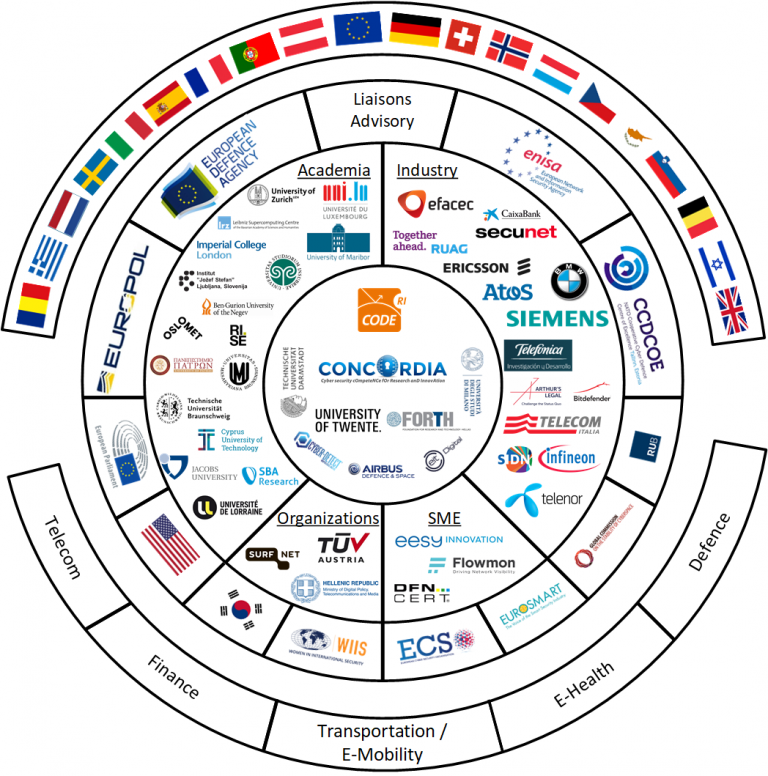
Position the CONCORDIA ecosystem, a Cybersecurity Competence Network with leading research, technology, industrial and public competences to build the European Secure, Resilient and Trusted Ecosystem, with the CODE research center as coordinator and hub, and ENISA as secretary.
-
Using an open, agile and adaptive governance model and processes.
-
Devise a cybersecurity roadmap to identify powerful research paradigms, to do hands-on experimental validation, prototype and solution development in an agile way to quickly identify successful but also unsuccessful potential product development.
-
Develop next-generation cybersecurity solutions by taking a holistic end-to-end data-driven approach from data acquisition, data transport and data usage, and addressing device-centric, network-centric, software- and system-centric, data- and application-centric and user-centric security.
-
Scale up existing research and innovation with CONCORDIA’s virtual lab and services.
-
Identify marketable solutions and grow pioneering techniques towards fully developing their transformative potential.
-
Develop sector-specific (vertical) and cross-sector (horizontal) industrial pilots with building incubators.
-
Launch Open Calls to allow entrepreneurs and individuals to stress their solutions with the development.
-
Set up an Advisory Board, comprised by leaders of industry, standardization, policy and politics to give strategic advice and also to connect with possible clients and users of the developed solutions, other projects and research initiatives, as well as important standardization and certification institutions.
-
Mediate between multiple communities: Different communities have different priorities and perspectives.
-
Establish an European Education Ecosystem for Cybersecurity. CONCORDIA, therefore, extends traditional training courses with new virtual courses (MOOCs and SPOCs) and a variety of outreach activities, including high-school curricula development, competitions, cyber ranges.
-
Provide expertise to European policy makers and industry.
 '
'
nIoVe
 '
'
ELE
European Language Equality (ELE) is a pilot project aiming to draw up a sustainable evidence-based strategic research agenda and roadmap, setting out actions, processes, tools and actors, to achieve full digital language equality of all languages (official or otherwise) used within the Union through the effective use of language technologies. The research agenda will lay out the current state of language technologies and language equality within the Union and give a detailed picture of the desired situation that is needed to achieve digital language equality. The roadmap will then provide the path and the means needed to implement the agenda and ensure that digital language equality becomes a reality by 2030.
IntelComp
EASIER
This project will create a tool to improve Deaf / hearing communication by developing technology to automatically translate sign languages into spoken or written language and vice versa. It will not be limited to a single spoken/signed language pair, but will be able to translate among multiple signed and spoken languages within the EU domain. The design of the app will be user-driven, while exhaustive evaluation procedures will be carried out by different stakeholders.
Using the app, Deaf users will be able to use their web cams to sign to a hearing user. Hearing users will be able to read the translation of the signed communication as text or hear the translation as speech. Hearing users will be able to speak or type into the app and Deaf users will be able to see the translation signed by an avatar that goes significantly beyond the state-of-the-art by incorporating a number of innovative grammatical and pragmatic features that convey more of the communicative information of the translated message than was previously possible.
For the purposes of the app development, state-of-the-art machine translation technologies will exploit a significant amount of structured European sign language resources along with unstructured big data of sign language videos from less resourced sign languages.
Moreover, in addition to the mobile app, other project outcomes will be a set of computer-assisted (human) interpretation tools, computer vision based language analysis tools and corpora building tools. These last two will assist users of under-resourced signed languages to develop additional corpora for use in the sign language technology pipeline that is at the core of the mobile app.
