Mediterranean Researchers’ Night Returns to Xanthi for the Third Consecutive Year
Artificial Intelligence, Robotics, Cultural Heritage and Sustainability come together in a celebration of science for all ages
23-09-2026
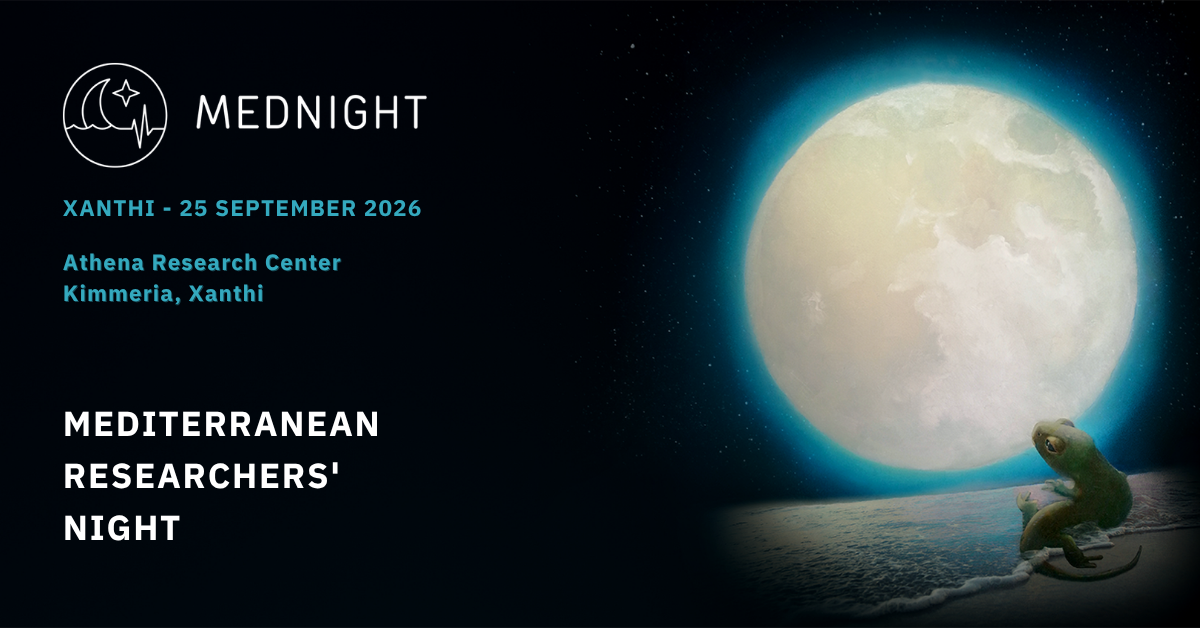
The Mediterranean Researchers’ Night (MEDNIGHT) returns to Xanthi for the third consecutive year on Friday, 25 September 2026, starting at 18:00, at the Kimmeria University Campus, following the great success of the previous two editions. With a strong focus on women in science, youth participation, and connecting science with everyday life, MEDNIGHT brings research closer to society than ever before.
Families, children and young people will have the opportunity to discover cutting-edge and innovative applications, meet and talk with scientists, take part in interactive games and workshops, and enjoy a unique hands-on experience centred on the technologies of the future.
Researchers from Athena Research Center will showcase technologies in Artificial Intelligence and Robotics and demonstrate how emerging technologies contribute to different areas of science and everyday life, including Culture, Health, Language, Archaeology, the Environment and Sustainable Development.
MEDNIGHT 2026 features more than 20 activities presented by Athena Research Center and collaborating organisations. Visitors will have the opportunity to explore Greek large language models such as Krikri, as well as the new generation of models being developed within the Pharos AI Factory, laying the foundations for reliable AI applications for the Greek language. They will also be able to play interactive games promoting healthier lifestyles, such as Vitalia, experience simulations of emergency scenarios and 3D virtual environments of monuments, and interact with dynamic digital twins through ARTEMIS TWIN EU. Visitors will also discover ARGUS, which combines data from sensors, drones, satellites, digital imaging and Artificial Intelligence to identify risks at an early stage and support the preventive protection of cultural heritage.
At the same time, they will learn how AI and Robotics can support the digitisation and preservation of textile cultural heritage through TEXTaiLES, and how textile fibres can be identified using a mobile phone camera through FiberScope. The programme also includes NoeSI, focusing on the secure design of microchips using AI agents; AQUAMON, which applies AI and Robotics to the smart monitoring of urban water quality; UNICHE, offering interactive cultural heritage experiences; and ThrombUS+, where a wearable device turns prevention and exercise into an engaging, game-based experience.
There will also be a rich programme of activities for children and young people. Young visitors will become archaeologists for a while by taking part in a hands-on excavation experience. They will examine minerals and rocks, as well as a fragment of a real meteorite, exploring their structure and properties. Through a STEM-based approach, children will also participate in experiential activities focusing on water, energy, biodiversity, natural resources and waste management.
The evening will also host the 5th Retro Computer Exhibition, featuring authentic computers, original hardware, screens, sounds and software from another era — an experience that will bring back memories for older visitors while giving younger generations the opportunity to discover the history of computing first-hand.
MEDNIGHT has been recognised as a project of the International Decade of Sciences for Sustainable Development 2024–2033, a global initiative led by UNESCO that aims to strengthen the contribution of science to achieving the Sustainable Development Goals while reinforcing the links between research, public policy and society.
The MEDNIGHT consortium includes Università degli Studi di Messina (Coordinator), CIEMAT, Marie Curie Alumni Association, Genopolys, CHU Toulouse, Athena Research Center, SciCo, University of Sarajevo, European Women Rectors Association and El Caleidoscopio, together with a wide network of collaborating organisations.
More information: https://mednight.athenarc.gr/2026/
MEDNIGHT has been recognised as an initiative endorsed by the International Decade of Sciences for Sustainable Development (2024–2033), led by UNESCO, which aims to strengthen the contribution of science to achieving the Sustainable Development Goals while reinforcing the links between research, public policy and society.