Athena RC at the ELIXIR All Hands Meeting 2026
ELIXIR-GR
16-06-2026
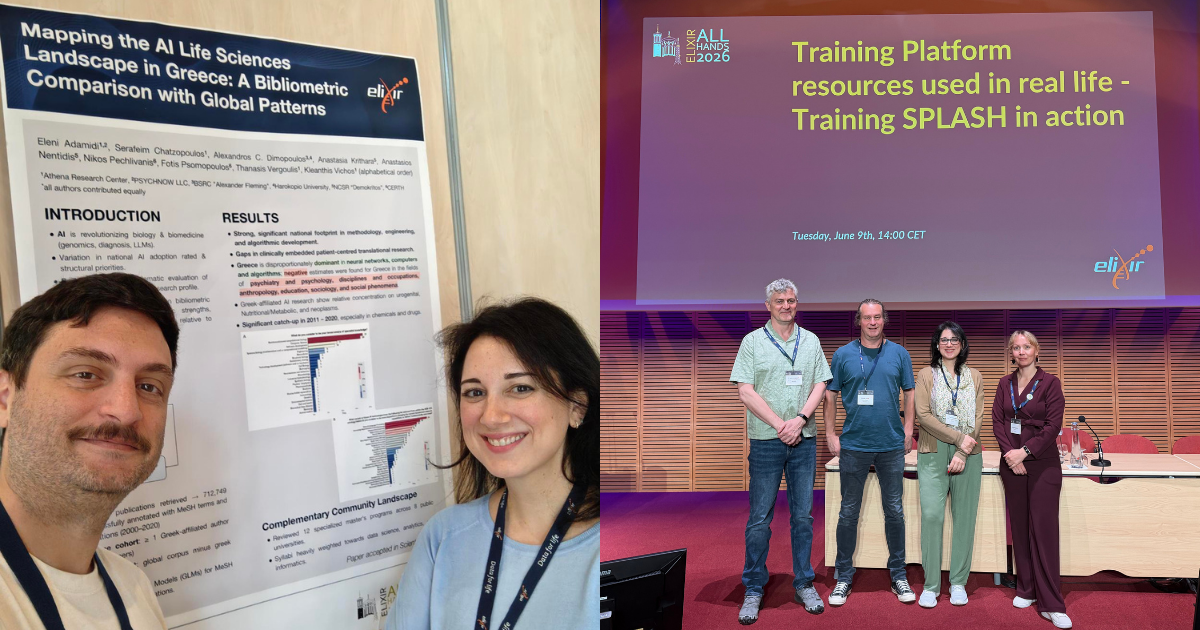
Researchers from the Institute for the Management of Information Systems (IMSI) of Athena Research Center participated in the 12th ELIXIR All Hands Meeting (8 -10 June 2026, Lyon, France) as part of the ELIXIR-GR delegation.
The annual gathering brings together the ELIXIR community from across its 24 European nodes and partner organisations for workshops, mini-symposia, plenaries, and poster sessions covering topics from federated data and human genomics to AI, machine learning, and research data management.
Thanasis Vergoulis, Principal Researcher, and Eleni Adamidi, Research Asssociate, attended on behalf of IMSI/Athena RC, contributing across multiple sessions spanning research, training, and infrastructure:
- Athena RC co-led a community workshop within the Compute Platform track, "Towards standardized tool and infrastructure usage metrics", focused on making compute usage visible across ELIXIR through a shared execution reporting schema covering tools, data, infrastructure metrics, and provenance.
- Thanassis Vergoulis and Maria Makaronidou (online) co-led the workshop "Crediting non-traditional research artefacts in the Life Sciences across ELIXIR", which addressed the underrecognition of key research outputs, such as curated datasets, software, workflows etc., and explored how credit for these contributions can be better captured and represented, building on ELIXIR infrastructures including BIP! Scholar (developed by IMSI).
- Eleni Adamidi, co-leader of the Training Metrics Database (TMD), participated in the Training Platform Mini-Symposium where TMD was presented. This tool streamlines data collection, storage, and visualisation for assessing the quality and impact of diverse ELIXIR training services. It captures audience demographics, post-training feedback, and the longer-term impact of training events on participants' work.
- They presented their study Mapping the AI Life Sciences Landscape in Greece: A Bibliometric Comparison with Global Patterns, recently published in Nature Scientific Reports, in the poster session. The research draws on a data-driven analysis of over 900K AI-related life science papers, comparing publication patterns from Greek institutions with global outputs (read the paper here).